
At a glance.
The A110 S is a small, light, mid-engined coupé with a 300 PS four-cylinder turbo. It has less power than its rivals on paper and is more fun than almost all of them on the road. Production ended in 2026, so almost every one you buy now is used.
The verdict
Buy an A110 S if you want the most involving car you can get for the money and can live with two small boots. It's light enough that everything wears slowly. It's cheap to service by sports-car standards, robust enough to use every day, and still holds its value better than most cars at the price. Its weaknesses are practicality, some cheap-feeling cabin plastics, and a ride that's firmer than the standard A110's. If you won't go on track, a standard A110 or GT may suit you better, and plenty of journalists agree.
Why you'd buy one
- About 1,100 kg: you feel everything through the seat and steering
- Predictable and playful at the limit, even in the wet
- £650 for a dealer service with brake fluid (the owner's last bill)
- Strong values: spec and age matter more than mileage
What you live with
- About 200 litres of luggage in two boots, and no cup holders
- Fixed buckets that adjust with spanners, not buttons
- Road tax of about £640 a year in years two to six
- Heat builds up on long track sessions
What to check
- Fuel pump recalls done (two UK campaigns)
- Coolant expansion tank and hoses for leaks
- Battery health: they drain when left standing
- Which version it is, and whether the aero kit is fitted
Who it's for
The A110 S suits a driver who wants one car that's genuinely exciting on a B-road, comfortable enough for a long weekend away, and cheap enough to use hard. The owner drives his to work, through winter on a second set of wheels, and on track days. If you need four seats, a big boot or a manual gearbox, look at the rivals instead.
The short buying advice
- Best all-rounder for road and track: a 2022-on A110 S (300 PS, Apple CarPlay), ideally with the aero kit. Expect £48,000–£58,000.
- Best value: a 2019–2021 A110 S (292 PS). The same chassis for around £40,000–£44,000.
- Best for the road only: a standard A110 or GT. Softer, and many testers think it's the sweeter car.
- Don't buy without: full dealer history, proof the recalls are done, and a check for coolant leaks.
Episode out Tue 1 Dec 2026 at 18:00. Research current to 9 November 2026. Fact-checked twice.
Every figure in this guide was checked twice against the episode and our sources. Claims that rest on a single source we couldn't confirm independently, including figures the owner gave from his own experience, carry a ◆.
The owner's story.
The owner has owned a tuned Supra, a supercharged Lotus Exige and an M2 Competition. He paid £52,000 for a 1,100 kg French coupé instead. Over 75 minutes he explained why, and what living with it is really like.
Why not an R8?
Alistair opened the episode with the obvious question. An Audi R8, a Mercedes-AMG GT or a Nissan GT-R all cost about the same as the owner's car. Every one of them has more cylinders, more power and more presence. So why would anyone buy the Alpine?
The owner's answer came in three parts. It's the easiest of them to live with. He can drive it as hard as he likes, whenever he likes. And it costs him almost nothing to run. Its width is never an issue, and he doesn't have to fret about the front lip everywhere the way R8 owners do. "It's just an easy car to live with," he said. "But when you drive it, it offers an experience that is something more than you can sum up with the numbers."
That idea runs through the whole conversation. Alistair pointed out that the fastest hypercars are now chasing 2,000 horsepower, a figure nobody can ever use on a road. Meanwhile the cars enthusiasts get most excited about are going the other way: lighter, simpler, often with a manual gearbox. The owner thinks buyers have noticed. "Experience is probably the thing people are realising is more important than the pure numbers," he said. "That's what this car does. It provides an experience that isn't suggested by the numbers."
This is the last true driving experience that isn't ridiculous.A110 S owner
His car
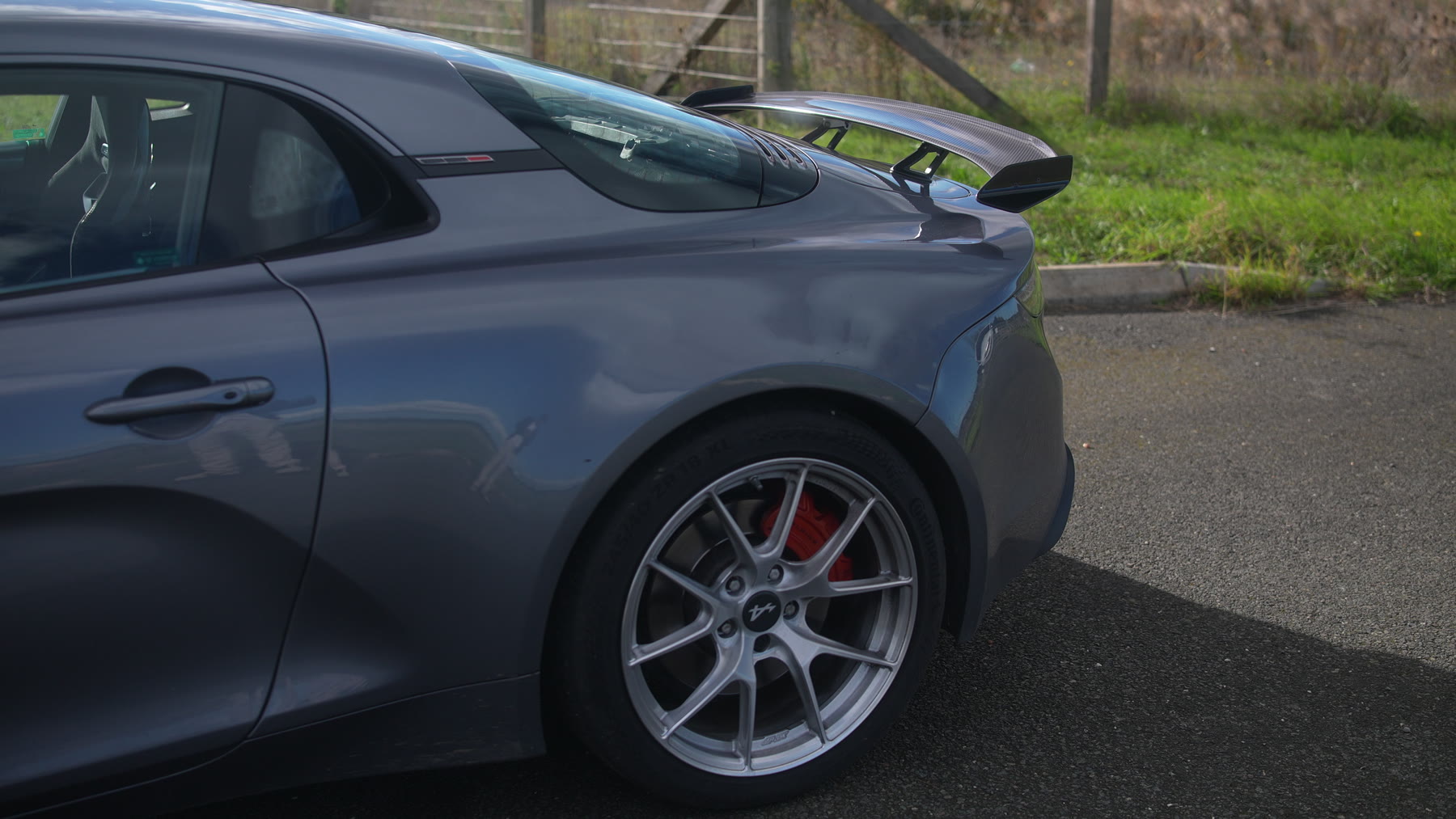
The owner's car is a 2023 A110 S, built after the 2022 update, which raised the S to 300 PS and added Apple CarPlay and Android Auto without changing the look. It's what he calls "quite a speccy one", with about £10,000 of factory options. The most visible is the factory aero kit: a carbon rear wing and a carbon front lip. The kit is expensive enough that it's rare on UK cars, so his draws more looks than most A110s. He says the kit genuinely works and adds real downforce. The car also has optional paint, orange stitching and orange seatbelts, an upgraded sound system, and the lightweight Sabelt bucket seats that come as standard on the S.
The wing is tougher than it looks. During filming Alistair pulled a suction-cup camera mount off it and found a round dent where it had been. He thought he'd broken the owner's expensive wing, but the mark turned out to be, in their words, "self-healing".
New, the car would have cost about £72,000. The owner bought it used for £52,000. A year and three months and 17,000 to 18,000 miles later, he says cars like his are still selling for around £49,500. "This was an expensive car," he said, "but used, it made a great value purchase."
How it drives
For the episode, the owner drove Alistair along a wet, broken back road. At one corner the surface changed halfway round, with a motorway just the other side of a wooden fence. The owner took it at about 60 mph. Alistair said that in a Lamborghini he wouldn't have pushed anywhere near that hard. In the Alpine it "felt unreal almost".
The grip is only half the story. What owners describe is how the car behaves when the grip runs out. "If they are going to go, it's so easy to mess around with," the owner said. "You can prod it to slide out of a corner if you want to. Or you can hold it on a line." Brake hard into a corner and the back will rotate. Lift off and you can shift the weight. Get on the power early and there's enough torque to start a small slide on the way out. Heavier modern cars, he points out, either fight that or hand it over to the electronics.
The suspension is set up for real roads. The A110 has generous suspension travel and ground clearance, which the owner puts down to the original car's rallying history. That's why it copes with bumpy British B-roads that would unsettle stiffer cars. Alistair admitted he still tensed up as a passenger, "and I had no need to".
The engine is a small turbo, so there's a brief pause when you get back on the throttle: "maybe two tenths of a second where you feel it build back in". The owner likes it. The car settles before the torque arrives, which makes it easier to drive hard out of a corner than a big V8 that can break traction instantly. "The way it just pushes itself out of corners is insane," he said. The dual-clutch gearbox has short ratios, so you're always changing gear. With the engine just behind your head, you hear the intake and the turbo fluttering on every lift. Alistair said you hear more of it than in a McLaren 600LT he'd been in.
It isn't a drag racer. "This is not an acceleration car. This is a handling car," the owner said. Even so, his tuned car runs 100 to 200 km/h in about 8.5 seconds, which he says is close to what a Lamborghini Gallardo or Ferrari F430 can do.◆
What it costs him
This is where the A110 really separates itself from the cars it's compared with. The owner's last full service at an Alpine dealer, including brake fluid and a few other jobs, came to about £650. "And that's paying over the top through Alpine dealers," he said. For comparison he mentioned a Nissan GT-R, which needs servicing every six months and costs its owners £2,000 to £3,000 a year in maintenance.
On track, the gap gets bigger. A road tyre for the Alpine is about £100. Even the stickiest semi-slick tyres are around £200 each. Brake discs are about £200 an axle. A set of tyres for a Ferrari, Lamborghini or McLaren, he said, can be £1,600 or more. Alistair added that a worst-case day in the Alpine, where you cook the discs and the tyres, still costs under £1,000. A gearbox failure in a Gallardo is £5,000 before anything else goes wrong.
Because the car is so light, he says, "the consumables barely even get used". On the drive to Wales for a road trip he got 40 mpg. Over the next four days he covered 800 miles from there, four or five hours a day at the wheel, without the car once feeling like hard work.
What's gone wrong
In 15 months and more than 17,000 miles, including track days, the owner has had two problems. One was his own doing: with his uprated intercooler fitted, running the engine cover changed how a coolant hose sat, and it rubbed through and split. He cut a new hose and fitted it. "The only problems I've had have been self-inflicted," he said.
The other is a fault the owner says is common on these cars: the coolant expansion tank can develop a pinhole crack at the top. Because the part is shared with the Renault Clio and other cars, it costs about £60, and it's held on by two clips and a bolt. The owner changed his in ten minutes, coolant included. His plan is simply to fit a new one every three or four years.
He's relaxed about the rest of the car. The engine is a common Renault unit that isn't stressed hard. He says no UK owner he knows of has had a gearbox fail, including cars that have done 90,000 and 120,000 miles.◆ "It doesn't make much power and it's light, so it doesn't put much stress on it," he said. "People just don't have issues with the actual mechanicals. It's always weird things like rubber seals, which you get on any car."
What he's changed
The owner collected the car with an aftermarket exhaust in the passenger seat and an uprated intercooler in the front boot. Since then he has fitted a downpipe and a mild engine tune. He puts the car at about 340 hp and 440 Nm, from the standard 300 PS and 340 Nm. He has also fitted forged wheels made for the car, with centre caps that make them look standard (Alistair assumed they were a factory option), and had the alignment set up.
Most of the other changes deal with the A110's one real weakness on track: heat. "Small turbo engine and small car, they are going to generate a lot of heat," he said. He has added ducting under the car and to the brakes. He also cut away the plastic surrounds around the exhaust tips and replaced them with metal ducts that leave a gap around each pipe. As the exhaust gas rushes out, it pulls hot air out of the engine bay with it. "It's little things like that," he said.
He isn't unusual. "People aren't leaving these cars stock," he said. "If you look at the owners' groups, I'd say the majority of people do the same sort of stuff." The Modifying chapter covers what's available and what it costs.
Living with it every day
The owner uses the car daily, including through winter. He keeps a second set of wheels with winter tyres and still drives it in the snow. "I could rag it around in minus temperatures and it was the best thing ever," he said. His point is that the car is cheap and robust enough to use, rather than sitting in a garage waiting for a sunny weekend.
It has everything he wants and nothing he doesn't: a good stereo, Apple CarPlay, and very bright LED lights. "It's the only car I've ever been in where you'll be on dipped beam and you're still getting people flashing you," he said. It doesn't have the beeps and driver aids of most new cars, which he counts as a plus.
The weak spot is practicality. "Practicality is the biggest issue on the car," the owner said. There are no cup holders, which is his biggest complaint. Inside there's only a small cubby behind the seats and a tray under the gear selector. The two boots, one in the front and one in the back, are oddly shaped, but between them they took four duffel bags for a long weekend away for two. You won't be fitting a pram or garden furniture. The fixed bucket seats are comfortable, but you have to unbolt them to change the angle.
It's also easy to work on. "You can drop all the undertrays off and you get full access," he said. "You can get both your arms down the side of the engine." For a mid-engined car, that's rare.
"It's probably the car with the least driving flaws I've ever had, but the most practicality flaws, other than the Lotus."The owner, on the A110 S
The looks, and the people it attracts
The owner didn't like the look of the A110 when he bought it. "I bought it thinking I hated the looks," he said. "I bought it solely after driving it." The car has grown on him, round lamps and all. Those round lamps in the nose are main-beam lights, and the design deliberately echoes the original A110 rally car. Plenty of people stare because they don't know what it is. Alistair likes the front but is still unsure about the rounded rear.
The A110 doesn't attract the show-off crowd who want to send a car down a city street, the owner says. Many owners have far more expensive cars as well. He knows owners of McLaren P1s who still drive A110s, and one owner who keeps three of them in three different places. When he takes friends with supercars out in it, "they laugh and have a good time".
Is it a baby supercar?
Alistair's description is "a hot hatchback built into a supercar body": light, mid-engined and rear-wheel drive. The owner hesitated before agreeing, because it's an overused phrase, then did: "it's a baby supercar." He has driven Porsche GT4s and GT3s, McLaren LTs and Ferraris. In his view the Alpine gives a similar experience "for half the cost, if not less", and on a public road it's more fun because you can actually use it. "I will push this car harder than you'd ever want to push a 488," he said, "because at that point you're risking it."
Would he buy another?
Alistair asked what he'd buy if he got his money back today. The owner didn't hesitate: "If I was going to stay in a sports car, it would have to be another one of these." He wouldn't go back to a Lotus Exige as a daily car. A two-car setup doesn't work for him either, because the fun car ends up sitting unused all winter. Before the Alpine, the closest alternative he considered was a Porsche Cayman GT4. A friend of his who also owns an A110 has looked for a replacement, test-driving cars as different as the new Corvette Z06, and concluded the only upgrade is an A110 R.
On values, he's careful not to promise anything. What he will say is that the A110 holds its money really well, and Alistair reckons it does better than almost anything at the price. He also says that spec and age matter far more to buyers than mileage. He has seen a standard 2020 or 2021 car with 90,000 miles sell for about £35,000, which he reckons is roughly two-thirds of its price new.◆ There's more on values in Prices and values.
History and versions.
Renault revived the Alpine name with one idea: build a modern car the way the original A110 rally car was built, small and light. Over nine years it made about 28,700 of them,◆ in more versions than most buyers realise.
The idea
The original Alpine A110 was a tiny, rear-engined French sports car from the 1960s that went on to win rallies and the first World Rally Championship in 1973. When Renault brought the name back, the brief was to capture that spirit rather than chase power figures. The new car has an aluminium body and chassis, a mid-mounted 1.8-litre turbo engine, double-wishbone suspension at both ends and a seven-speed dual-clutch gearbox. It weighs about 1,100 kg, and 56% of that sits over the rear wheels. Every one was built at Alpine's factory in Dieppe, on the Normandy coast.
Timeline
- Alpine Vision concept shown in Monaco in February. It previews the production car almost exactly.
- A110 revealed at the Geneva show in March. The Première Édition, limited to 1,955 cars (a nod to 1955, the year Alpine was founded), had already sold out within days of pre-orders opening in December 2016. UK price £51,805.
- Pure and Légende go on sale in the UK at £46,905 and £50,805. Pure is the light, simple one. Légende adds comfort seats, more kit and larger wheels. UK deliveries begin that summer through seven Alpine centres.
- A110 S revealed in June and on sale in the UK from 3 September at £56,810. More power (292 PS), a stiffer chassis and bigger brakes.
- Special editions arrive: the Légende GT (400 cars) and the yellow Color Edition, based on the S.
- The range is reorganised. Pure becomes plain A110 (252 PS), Légende becomes GT (now 300 PS), and the S rises to 300 PS and 340 Nm. New software brings Apple CarPlay and Android Auto, and the S can be ordered with a factory aero kit. In December the track-focused A110 R goes on sale at £89,990. More limited editions follow, including the Tour de Corse 75 and R Fernando Alonso.
- The San Remo 73 limited edition goes on sale in March. In December Alpine announces the R Turini: an R with alloy rather than carbon wheels, at £91,490.
- The 2024 S gets a rear spoiler, front lip and forged 18-inch Fuchs wheels as standard and costs £67,490. The R Ultime is revealed in Paris: 110 cars, 345 bhp, from about £276,000.
- The final range. In February the GT and S are replaced by one car, the GTS, which has the S chassis with GT comfort (£67,311). The R 70 marks Alpine's 70th birthday. In October Alpine confirms the last 1,750 cars.
- The end of the line. The last petrol A110, an R 70 in Alpine Blue, leaves Dieppe around 1 July. Around 28,700 second-generation cars were built. An all-electric A110 will follow on Alpine's new platform, also built in Dieppe.◆
The two A110 S models
There are really two A110 S models, and it matters which one you're looking at.
2019 to 2021: the 292 PS car
The first S has 292 PS and 320 Nm, and it makes its peak torque over a wider rev range than the standard car. It does 0–62 mph in 4.4 seconds and tops out at about 162 mph. These are the cheapest S models today. The infotainment is the original system, without Apple CarPlay or Android Auto, and it's slow. Owners on the forums are split: some prefer the eagerness of the 292 car at the top of the rev range.
2022 to 2025: the 300 PS car
From the 2022 model year the S has 300 PS and 340 Nm. It's quicker (0–62 mph in 4.2 seconds) and has smartphone mirroring, over-the-air software updates and a telemetry screen that shows boost, gearbox oil temperature and lap times. It's also the only S you can find with the factory aero kit. From the 2024 model year the S came with a rear spoiler, front lip and forged Fuchs wheels as standard. Check whether a 2024 car has the full carbon aero kit with the large wing, because the sources don't make it clear. The owner's car is a 2023 300 PS car.
What makes an S an S
Every A110 S shares the same changes over the standard car, and they're all about the chassis:
- Springs 50% stiffer, with retuned dampers.
- Anti-roll bars twice as stiff (hollow on 2022-on cars).
- Ride height 4 mm lower.
- 320 mm Brembo brakes with orange calipers, which were a £936 option on the standard car at launch.
- Wider 18-inch tyres: 215/40 front and 245/40 rear on the GT Race wheel.
- Sports exhaust as standard, plus an option to switch the stability control fully off.
The result is a car with much less body roll and pitch, sharper on a circuit and a little busier on a bumpy road. Whether that's an improvement depends on where you drive. What the press said covers the debate.
The rest of the family
A110 / Pure (252 PS)
The purest and lightest road car, at about 1,098 kg. Soft by sports-car standards, and the one many journalists love most. From the 2024 model year it got 18-inch wheels and 320 mm front discs as standard.
Légende and GT
The comfort models. The Légende (2018–21, 252 PS) has six-way adjustable leather seats, Focal audio, parking sensors and a camera, and weighs 1,123 kg. The GT (2022–25) adds the 300 PS engine with the softer chassis, heated leather comfort seats on later cars, and blue calipers. If you want the S's engine and you'll mostly drive on the road, the GT is a serious alternative.
GTS (2025–26)
The final A110 before production ended. It combines the S chassis with GT comfort and could be ordered with an R-style aero kit. Few will appear on the used market for a while.
R, R Turini, R 70 and R Ultime
The track cars. The R has the same 300 PS engine as the S but weighs about 30 kg less, mostly thanks to carbon: carbon bonnet, carbon wheels and a carbon rear deck with no rear window. It has adjustable dampers, Michelin Cup 2 tyres and Sabelt track seats. The R Ultime is a different animal: 345 bhp, 110 cars and a price above most supercars. As the owner puts it, the S and GT give you "the majority of the experience" for far less money: on list prices the R cost roughly £25,000–£35,000 more than an S.
Which one to buy.
There's no single best A110. The right one depends on how much track driving you'll do, how much you value comfort, and whether you want CarPlay or the cheapest way in.
By how you'll use it
Mostly road, some long trips
Look at a standard A110 or a GT. The softer suspension suits British roads, and several respected testers think it's the most charming version. The GT gives you the 300 PS engine with comfort seats. A 2023–24 base car currently costs about £43,500–£47,000 from a dealer, and a 2022–24 GT about £48,000–£53,000.
Road and regular track days
This is what the S is for. The stiffer chassis, bigger brakes and wider tyres make it faster and more composed on a circuit. The owner tracks his and wouldn't have anything else. Aim for a 2022-on car if your budget allows, for the extra torque and the modern infotainment.
Mostly track
Consider an R. It costs far more (about £70,000 at auction and £75,000 or more from dealers) but it's lighter, comes on Cup 2 tyres and has adjustable dampers. Or buy an S and modify it the way many owners do, as covered in Modifying.
By budget
| Budget | What you'll find |
|---|---|
| £27–35k | Early Pure and Légende cars, usually higher mileage or bought at auction |
| £35–45k | Première Éditions and Légendes, and the cheapest 2019–21 S models |
| £45–55k | 2022–23 S and GT models, the cheapest 2024 S and GT, and nearly new standard cars |
| £55–62k | Low-mileage or high-spec 2024 S models; special editions like the San Remo 73 |
| £70k and up | A110 R, R Turini and the limited R editions |
These ranges come from dealer listings on 9 November 2026 and recent auction results. See Prices and values for the full data.
292 or 300: which S?
The 300 PS car is the better ownership proposition. It has more torque, CarPlay and Android Auto, the telemetry screen, and the option of the aero kit. The 292 PS car is the cheaper way into an S, often £6,000–£10,000 less for a similar mileage. It has the same chassis changes and is arguably a touch more eager at high revs. If you'll use your phone for navigation every day, pay the extra for the 300.
The spec to look for
The owner's view is that spec and age matter much more to A110 buyers than mileage. The options that make a car easier to sell are the factory aero kit, the carbon roof, forged Fuchs wheels and Atelier paint. Avoid cars with an unexplained change of seats or wheels unless the originals come with the car. The Options chapter explains each one.
Specifications.
Every A110 uses the same 1.8-litre turbo engine, the same seven-speed dual-clutch gearbox and the same aluminium structure. What changes between versions is power, chassis tuning, wheels, seats and weight.
| Pure / A110 | Légende | S (292) | GT | S (300) | R | |
|---|---|---|---|---|---|---|
| Years (UK) | 2018–26 | 2018–21 | 2019–21 | 2022–25 | 2022–25 | 2022–24 |
| Power | 252 PS | 252 PS | 292 PS | 300 PS | 300 PS | 300 PS |
| Torque | 320 Nm | 320 Nm | 320 Nm | 340 Nm | 340 Nm | 340 Nm |
| 0–62 mph | 4.5 s | – | 4.4 s | 4.2 s | 4.2 s | 3.9 s* |
| Top speed | 155 mph | 155 mph | 162 mph | 155 mph | 162 mph† | 177 mph |
| Weight (DIN) | 1,098 kg | 1,123 kg | 1,114 kg | 1,119 kg | 1,109 kg | 1,082 kg |
| Chassis | Standard | Standard | Sport | Standard | Sport | Adjustable dampers |
| Brakes (front) | 296 mm‡ | 296 mm | 320 mm | Brembo, blue | 320 mm | Brembo, extra cooling |
| Wheels | 17 in‡ | 18 in | 18 in | 18 in | 18 in | 18 in carbon |
| Seats | Sabelt buckets | Comfort, leather | Sabelt buckets | Comfort, leather | Sabelt buckets | Sabelt track |
| UK price new | £46,905 | £50,805 | £56,810 | £59,355 | £59,955 | £89,990 |
*0–100 km/h. †171 mph with the aero kit. ‡From the 2024 model year the A110 has 18-inch wheels and 320 mm front discs. Prices are at each version's UK launch: the S (300) rose to £67,490 for 2024. Weights are DIN (without driver). The EU figure, with a 75 kg driver, is about 75 kg higher.
Shared by every A110
| Engine | 1,798 cc four-cylinder turbo, petrol, direct injection, timing chain |
| Gearbox | Seven-speed wet dual-clutch automatic (Getrag), rear-wheel drive |
| Layout | Mid-engined, 44% front / 56% rear weight distribution |
| Suspension | Double wishbones front and rear |
| Body | Aluminium, built in Dieppe, France |
| Length / width / height | 4,180 / 1,798 / 1,252 mm |
| Wheelbase | 2,420 mm |
| Luggage | 100 litres front, 96 litres rear |
| Fuel tank | 45 litres |
| Drag coefficient | 0.32 |
| Insurance group | 44–50 across the range; S is group 48◆ |
Options and spec.
The A110 had a short options list, but a few items make a big difference to how a car looks, how it drives and how easily it sells. The owner's car carried about £10,000 of them.
Aero kit
Offered on the S from the 2022 model year. It adds a carbon rear wing, a carbon front blade and longer underbody panels that make the rear diffuser work harder. Alpine says it adds about 60 kg of downforce at the front and 81 kg at the rear at top speed, and raises the top speed from 162 to 171 mph. It was expensive enough that few UK cars have it, which makes it sought after. The owner says it makes a real aerodynamic difference. We couldn't find an official UK price. In the episode, the owner and Alistair put it at around £6,000.◆
The other options that matter
| Option | What it is | Price new |
|---|---|---|
| Carbon roof | Gloss carbon roof panel on the S and GT. Saves about 2 kg, mostly for looks | £2,160–2,208 |
| Matt paint | For example, Thunder Grey matt on Top Gear's long-term A110 S (2026) | £4,400 |
| Atelier paint and trim | Alpine's personalisation programme, like BMW Individual. Atelier cars were among the dearest used A110s in 2021 | Not published |
| Forged Fuchs wheels | Lighter 18-inch forged wheels. Standard on the 2024 S, optional before | Not published |
| Focal audio | Upgraded sound system (Premium Focal on some versions) | £552–1,104 |
| Active sports exhaust | Standard on the S, an option on others at launch | £1,380 (2018) |
| 320 mm brakes | Standard on the S, an option on early standard cars | £936 (2018) |
| Heated seats | Heated Sabelt seats on the early Pure | £1,800 (2018) |
| Sensors and camera | Front and rear parking sensors plus reversing camera | £1,140 (2018) |
Seats: buckets or comfort
The S comes with fixed Sabelt bucket seats, each about 13 kg. They're comfortable and supportive, but you change the backrest angle by unbolting the seat, so set them up for the main driver when you buy the car. The comfort seats in the Légende and GT adjust six ways and were heated on later cars. If more than one person will drive the car regularly, that matters.
What adds value
No source puts a figure on how much any option adds at resale. Dealer adverts give a clue: they lead with the carbon roof, Fuchs wheels, Atelier paint and the aero kit. The owner is clear that spec is the biggest factor in what an A110 is worth, ahead of mileage. A well-specced S with the aero kit should always be easier to sell than a plain one.
Prices and values.
The A110 barely lost value for its first three years. Since 2021 early cars have dropped by roughly 20% to 35%, but nearly new cars still lose less than most sports cars at the price.
Price history
The lines show what an A110 cost new in the UK. The dots show real used cars: dealer asking prices and auction results, each dated. Tap a series to hide it.
Sources: Alpine UK launch prices; Autocar, Auto Express, Carbuyer and PistonHeads price reports; PistonHeads classifieds (9 Nov 2026); Collecting Cars results reported by Classic.com◆; the owner's own purchase.
What a used S costs today
| Year | Version | Miles | Asking | Price new | Drop |
|---|---|---|---|---|---|
| 2020 | S (292) | 24,800 | £40,500 | £56,810 | −29% |
| 2021 | S (292) | 19,636 | £43,499 | £57,140 | −24% |
| 2023 | S (300) | 11,532 | £49,995 | £61,990 | −19% |
| 2024 | S (300) | 3,074 | £53,995 | £67,490 | −20% |
| 2024 | S (300) | 6,662 | £57,699 | £67,490 | −15% |
Asking prices from PistonHeads classifieds. "Price new" is the base list price for that model year (2021 from PistonHeads, December 2020), before options, so the real drop on a well-specced car is bigger. Cars sell for less than their asking price.
How values have moved
For its first three years, the A110 barely depreciated. In September 2021 PistonHeads found low-mileage 2018 Première Éditions advertised at £48,000–£56,000, against a price new of £51,805, and a 2019 S at £55,000. Depreciation, it said, hadn't really touched them.
That changed as more cars reached the used market and new prices rose. By September 2023 used A110s were advertised between £42,000 and £70,000. At auction, Première Éditions have sold for between about £33,000 and £45,000 (sale dates not confirmed). That's a fall of roughly 20% to 35% from their 2021 asking prices, though asking prices are always higher than what cars actually sell for. A 2019 Légende made £27,030 in April 2026. It's still a gentle curve for a car this age.
Newer cars are losing about 15–25% in their first two or three years, against base prices that rose sharply. A 2024 S cost £67,490 new, about £11,000 more than a 2019 S. The owner's own car shows how slowly a well-specced S moves now: he paid £52,000, and 15 months and 17,000–18,000 miles later he puts equivalent cars at about £49,500.
What holds value best
- Limited editions and the R family. Even so, a 2023 R sold for £69,500 in February 2026, against £89,990 at launch (£96,990 by 2023), so they aren't immune.
- Well-specced S models with the aero kit, carbon roof or Atelier paint.
- Low ownership counts and full dealer history.
Mileage matters less than you'd expect. The owner has seen a standard 2020 or 2021 car with 90,000 miles sell for about £35,000, which he reckons is roughly two-thirds of its price new.◆
Will it go up?
Nobody in the episode would promise that, and neither will we. Several things help the A110. Production has ended. About 28,700 were built across the whole range.◆ The electric replacement will be a very different car. And light, analogue cars are in fashion. Against that, there are plenty of cars, and early cars sell at auction for well below their 2021 asking prices. The realistic expectation for a good S bought today is slow depreciation, not profit. The limited editions are the likeliest to become collectable.
Problems and checks.
The A110 has no big mechanical weak spot. It has a timing chain, not a cambelt, and a widely used Renault engine. The faults that do come up are small, known and mostly cheap. Here's what they are and how to check for them.
Known faults
Battery drain
The most common complaint. The A110's battery runs down if the car isn't driven for a while, and a weak battery can throw up warning lights and error codes. Some owners suspect the keyless entry system adds to the drain. A battery maintainer (a trickle charger) for when the car is parked up is the simple fix.
Coolant leaks
The owner says the coolant expansion tank can develop a small pinhole crack at the top. He says it's a £60 part shared with Renault's mainstream cars and takes about ten minutes to swap, and he plans to replace his every three or four years as a matter of course. Owners also report leaks from coolant pipes and, less often, the electronic thermostat. Look for dried coolant residue around the tank and pipes, and watch the coolant level.
Fuel pump
The most serious fault the A110 has had. A fuel pump problem could stop the car starting or, rarely, cut power. It's covered by two UK recalls, listed below. Make sure both have been done.
Infotainment and electrics
The early system is slow, with patchy DAB reception and flaky Bluetooth, and pre-2022 cars have no Apple CarPlay or Android Auto. Software updates helped. Parking sensors can work loose and drop into the bumper, causing false warnings. The fix means taking a wheel and arch liner off.
Rattles and trim
Squeaks and rattles from the seats, the top of the dashboard and the centre console are common. They're irritating rather than serious. Wiper blades are unique to the car and expensive. There's no spare wheel, just an inflation kit, so check it's there.
Heat on track
A small turbo engine in a small car builds up heat in long sessions. That's why this owner, and many others, add cooling. Ask any seller who has tracked the car how they managed it.
Problems caused by modifications
The owner's only other fault was self-inflicted: after fitting an uprated intercooler, a coolant hose rubbed through under the engine cover. On a modified car, check for chafed hoses and wiring around anything that has been added.
UK recalls
| Issued / ref. | Problem | Cars affected |
|---|---|---|
| Jun 2019 | Front boot bolts not tightened correctly | 206 cars built up to Feb 2019 |
| Jun 2019 | Wiring loom could chafe on the exhaust | 166 cars built up to Nov 2018 |
| Jul 2019 | Engine oil pressure, fixed by a software update | 240 cars built Sep 2018–Jul 2019 |
| R/2023/239 | Fuel pump module: car may not start, or may stall◆ | About 192 cars built Oct 2018–Jan 2020 |
| Dec 2023 R/2023/347 | Fuel pump impeller friction can cut the fuel supply | About 811 cars built Sep 2017–Apr 2022 |
| Oct 2024 R/2024/425 | Rear wheel rims engraved with the wrong width, so the wrong tyres could be fitted◆ | About 6 UK cars built Apr–Sep 2024, believed A110 R only |
Recall work is free at an Alpine dealer. Check any car on the government's recall checker at gov.uk/check-vehicle-recall using its registration, and ask for paperwork showing the work was done.
Viewing checklist
- History. Annual dealer or specialist servicing at 12 months or 12,000 miles, with invoices. Look for brake fluid every three years and gearbox oil every fourth service.
- Recalls. Fuel pump campaigns and the 2019 recalls, shown on the history or the gov.uk checker.
- Software. Ask whether the infotainment and stop-start updates have been applied.
- Battery. Ask how the car has been stored. Look for warning lights on start-up.
- Coolant. Look for residue around the expansion tank, pipes and thermostat. Check the level when the engine is cold.
- Electrics. Test the parking sensors, camera, screen, Bluetooth, windows and air-con.
- Body. Check the front lip and underside for scrapes, stone chips on the nose, kerbed wheels, and paint and corrosion around the rear arches and bumper joins.◆ Check boot and window seals for water getting in.
- Track use. Look for worn semi-slick tyres, glazed or heavily worn brakes, and towing-eye marks. None of these rule a car out. Ask about them and price them in.
- Modifications. Get a list and the invoices. Ask whether the original parts come with the car, and tell your insurer.
- Drive it. The dual-clutch gearbox should be smooth when pulling away and in slow traffic. Listen for rattles over bumps, and for clatter from the timing chain when the engine is cold.
- Inflation kit. There's no spare wheel, so make sure the kit is in the car.
Running costs.
For a car that keeps up with supercars on a back road, the A110 is cheap to run. Servicing costs about the same as a premium hatchback's. Because the car is so light, tyres and brakes last a long time.
Servicing
Alpine specifies a service every 12 months or 12,000 miles. A routine dealer service costs about £330–£540, depending on the dealer and which service is due. There are a few extra jobs on longer intervals. The owner's most recent full service at a dealer, with brake fluid and a few other jobs, was about £650.
| Item | How often | Cost |
|---|---|---|
| Annual service | 12 months / 12,000 miles | £330–540 |
| Brake fluid | Every 3 years | ≈ £178 |
| Gearbox oil | Every 4th service | ≈ £242 |
| Coolant | Every 5 years | ≈ £384 |
Auto Express (2023), What Car? and PistonHeads. Prices vary by dealer.
The UK Alpine network has grown from seven centres in 2018 to about 20 in 2026, so finding a dealer is easier than it was. Some owners report dealers unfamiliar with the brand and waits for parts. Independent specialists will service the car too. Check that any warranty you rely on allows that.
Tax and insurance
Every A110 cost more than £40,000 new, so it pays the expensive car supplement on top of standard road tax in years two to six. In 2026–27 that comes to about £640 a year. From year seven it drops to the standard rate, about £200. The owner gave the same figure in the episode.
Insurance groups run from 44 to 50 across the range, and the S sits around group 48.◆ One comparison site gives an average quote of about £2,500 a year, but your own premium will depend on your age, postcode and record. Tell your insurer about any modifications.
Fuel
Official figures for the S range from about 34 to 41 mpg depending on the test and model year. Driven gently on a long run, the car does better than you'd expect. The owner got about 40 mpg on the drive to Wales, and one magazine says 45 mpg is realistic. The tank holds 45 litres, enough for roughly 350–400 miles of cruising.
Tyres and brakes
The S runs 18-inch tyres. Sizes depend on the wheel: 215/40 front and 245/40 rear on the GT Race wheel, 205/40 and 235/40 on some others, so check the label in the door frame. The standard tyre is the Michelin Pilot Sport 4, with Cup 2 track tyres as an option. The owner pays about £100 a tyre for road tyres and about £200 for the stickiest semi-slicks, and about £200 an axle for discs. For comparison, a set of tyres for a Ferrari, Lamborghini or McLaren can cost £1,600 or more.
Warranty
New A110s came with a three-year warranty: unlimited mileage for two years, capped at 60,000 miles by the end of year three. Most 2024 and later cars will still have some left. Dealers sell extensions. One quotes £265, £445 or £685 for one, two or three years.
A typical year
| Item | Per year |
|---|---|
| Dealer service (average, including extras) | ≈ £630 |
| Road tax (years 2–6) | ≈ £640 |
| Fuel (8,000 miles at 36 mpg, £1.40 a litre) | ≈ £1,415 |
| Tyres (a set every 2 years at £100 each) | ≈ £200 |
| Insurance (varies hugely) | £1,000–2,500 |
| Total | ≈ £3,900–5,400 |
Our estimate from the figures above. Fuel price and mileage are assumptions. Depreciation is not included.
Modifying.
Few A110s stay standard for long. Owners tune the engine, fit coilovers and wheels, and above all add cooling for track days. Done sensibly, the car takes it well.
The owner's car
The owner's 2023 S has an aftermarket exhaust, a downpipe, an uprated intercooler and a mild tune. He puts it at about 340 hp and 440 Nm, up from 300 PS and 340 Nm. It also has forged wheels with standard-look centre caps, an alignment, underbody and brake ducting, and his own heat extraction around the exhaust tips. The full story is in The owner's story.
Engine tuning
The best-known UK tuner for the A110 is Litchfield. Its Stage 1 software costs £720 including VAT and claims 310 PS (305 bhp) and 415 Nm. That's more power than a standard S, and on a 252 PS car it's a big jump. On 2022-on cars a newer engine computer limits how much extra torque is available, though power gains still apply. Other UK remappers offer similar figures. Bigger gains like his need hardware: a downpipe, an intercooler and an exhaust. Some European tuners claim close to 400 hp with a downpipe, but treat those claims with caution.◆
Suspension and wheels
Coilovers are the next most common change, mostly from Nitron and Öhlins. Litchfield sells a Nitron kit fitted with corner weighting and alignment. Lighter forged wheels sharpen the steering. Many owners do the same and choose designs that look original.
Cooling
If you plan regular track days, sort the heat first. Owners add an uprated intercooler, vented engine covers, underbody and brake ducting, and exhaust-surround changes like the owner's. Check that anything new near the engine is routed so it can't rub through a hose, which is exactly what happened to the owner.
Exhausts
Alpine itself sold an Akrapovič exhaust as an official accessory for the S and GT, which is the most straightforward choice if you care about keeping things factory-approved. Aftermarket systems are widely available. We couldn't confirm current UK prices for them.
Before you modify
- Warranty: a remap may affect any remaining factory or extended warranty. Ask the dealer and the tuner in writing before you go ahead.
- Insurance: declare every modification, or risk a claim being refused.
- Keep the original parts: a standard car is easier to sell, and buyers value the option of returning to standard.
- Buying a modified car: ask for invoices, a list of parts and a dyno sheet if there is one, and check the work was done by a known specialist.
Some owners go much further. The owner says people are already stripping A110s into full track cars and fitting complete carbon bodies, and some are spending as much as £100,000 doing it. It shows how good the basic car is.
The rivals.
Almost every rival in this money has more power. Almost none of them is as light. That one fact explains why the A110 S keeps winning arguments it should lose on paper.
The number that matters: weight
Put the A110 S next to its rivals and it loses the power contest almost every time. A BMW M2 has well over 450 horsepower. A Porsche 718 Cayman S has 345. The Alpine has 296. But the Alpine weighs about 1,110 kg, and most of its rivals weigh between 1,335 kg and 1,725 kg. Divide power by weight and the gap almost disappears.
| Car | Power | Weight | Per tonne | 0–62 mph |
|---|---|---|---|---|
| BMW M2 (G87, 2024 on) | 480 hp | ≈1,725 kg | ≈278 hp | 4.0 s |
| Alpine A110 S (2022 on) | 296 bhp | 1,109 kg | 267 bhp | 4.2 s |
| Alpine A110 S (2019–21) | 288 bhp | 1,114 kg | 259 bhp | 4.4 s |
| Lotus Elise Sport 220 | 217 hp | 845 kg | 257 hp | – |
| Lotus Emira i4 | 365 hp | 1,446 kg | 252 hp | ≈4.4 s |
| Porsche 718 Cayman S (PDK) | 345 bhp | 1,385 kg | 249 bhp | ≈4.2 s |
| Alpine A110 Pure | 248 bhp | 1,098 kg | 226 bhp | 4.5 s |
| Toyota GR Supra 3.0 | 335 hp | 1,495 kg | 224 hp | – |
| Porsche 718 Cayman 2.0 | 296 bhp | 1,335 kg | 222 bhp | 5.1 s |
| Porsche 718 Cayman T | 296 bhp | 1,350 kg | 219 bhp | 5.1 s |
Three things to know about this table. Power is as each source quotes it: "hp" is often metric PS, about 1.4% more than bhp. Manufacturers and magazines quote weight in different ways (with or without a driver, with or without options), so treat small gaps as a draw. And per-tonne figures only tell you how hard a car accelerates. They say nothing about how it feels when it's light: it turns in faster, stops shorter, and wears its tyres and brakes more slowly. That last part is the bit owners talk about.
Cars that feel the same
If what you want is a small, light, mid-engined car that talks to you through the steering and the seat, there are only a handful of choices.
Porsche 718 Cayman
The benchmark, and the car every A110 review compares it with. It's more complete: better built, more practical, a bigger dealer network, and a manual gearbox if you want one. The four-cylinder Cayman, Cayman T and Cayman S are about 225 to 275 kg heavier than the Alpine. The magazines are genuinely split on which is better. Porsche narrowly won evo's 2018 group test and CAR's 2018 group test, and also won a later Top Gear twin test against the A110 S. The Alpine won evo's 2021 rematch against the Cayman T, and PistonHeads called it the more alluring of the two even while calling the Porsche the more complete car. The fair summary is a draw that depends on what you value. Choose the Porsche for completeness, the Alpine for how it feels.
Lotus Emira
The closest modern rival in spirit: mid-engined, made for drivers, and the last petrol Lotus. It is also 250 to 370 kg heavier depending on whose figures you believe, and it was considerably dearer new. Used V6 First Editions now start in the high £50,000s. Reviewers praise its grip and composure. A few say the front end isn't as sharp as they hoped when pushed.
Lotus Elise and Exige
Even lighter than the Alpine, and far rawer. An Elise Sport 220 weighs 845 kg. An Exige Sport 350 or 410 is properly fast. Both are harder to live with: tight to get into, loud, firm and basic inside. The owner once had an original S1 Exige with a supercharged Honda engine, about 430 hp at the wheels in an 800 kg car. He calls it a wicked toy you can only drive when everything is perfect, and says he wouldn't want to drive an Exige every day. The A110 is the one he can.
Cars that cost the same
Used A110 S prices currently sit between about £40,000 and £58,000. At that money you can have something very different.
BMW M2 (G87)
Faster in a straight line, four seats and a proper boot. It weighs around 600 kg more than the Alpine, and the press has noted it's heavier than the old M2 too. Choose it if you want one car to do everything. In the episode, the advice for anyone chasing straight-line speed was a BMW M3 rather than the Alpine.
Toyota GR Supra 3.0
More torque, and a manual option on later cars. What Car? compared a Supra 3.0 with an A110 Légende and called the Alpine easily the best-handling sports car at the money. The Supra is about 380 kg heavier.
Older supercars
The question that opens the episode: an Audi R8, a Mercedes-AMG GT or a Nissan GT-R can all be bought for roughly the same as the owner's car. They have six, eight or ten cylinders and far more drama. They also cost far more to run, are wider and harder to place on a British B-road, and are much more nerve-wracking to use hard. The owner's story covers why he still chose the Alpine.
Which should you choose?
- You want the best driving experience at the money and will live with a small boot: the Alpine.
- You want one car that does everything, including a weekly shop: the Porsche 718 Cayman, or the BMW M2 if you need rear seats.
- You want something even purer and don't mind discomfort: a Lotus Exige.
- You want a supercar's theatre and can afford its bills: a used Audi R8.
What the press said.
The A110 is one of the best-reviewed sports cars of the last decade. The S is where the critics disagree: it's the track-day pick, and not every journalist thinks it's the best one for the road.
Where everyone agrees
Almost every review of the A110 praises the same three things: how light it is, how it rides, and how agile it feels. What Car? gives the A110 five stars and calls it one of the most entertaining sports cars you can buy, new or used. Autocar and CAR both rate it highly, and CAR notes the S cuts body roll and pitch dramatically compared with the standard car. Auto Express gives the range four out of five.
The criticisms are consistent too. The cabin plastics feel cheap for the money, especially in early cars. The infotainment is dated. Storage is limited. Some testers say the steering isn't quite as good as the chassis.
Where they disagree: the S
The S is stiffer, lower and grippier than the standard car. Most testers agree that makes it better on a circuit. Several respected writers think it gives up some of the base car's charm on the road:
- PistonHeads (Dan Prosser, December 2020) put a Pure against an S and chose the Pure. He thought the Pure felt more alive, while the S came into its own on track. Prosser owns a Pure, and says so.
- evo (Adam Towler, January 2023) praised the post-2022 S's superb chassis, but found it less distinctive than the base car or GT. He named the GT as the sweet spot of the range.
- Auto Express found the S stiffer and busier around town and preferred the standard car or GT for daily driving.
- Goodwood Road & Racing (Ben Miles, February 2021) didn't find the S harsh, but felt the brilliant feeling of the standard car wasn't there.
The owner chose the S because he uses his car on track. Which one to buy explains which version suits which owner.
The Porsche question
The A110 versus Porsche 718 Cayman twin test has been run again and again, and the results are split. Porsche won narrowly in evo's 2018 group test and CAR's 2018 group test ("by a thread"), and also won Top Gear's A110 S versus Cayman T test. The Alpine won evo's 2021 rematch, where Adam Towler concluded, "But for me the Alpine wins this test." PistonHeads' 2018 test called the Porsche the more complete package and the Alpine the more alluring one.
Awards
- Top Gear Performance Car of the Year, ahead of cars including the Bugatti Chiron, McLaren 600LT and 911 GT2 RS. Top Gear magazine also named it Sports Car of the Year.
- Second at evo Car of the Year, behind the McLaren 600LT and ahead of the Porsche 911 GT2 RS.◆
- Motor Sport magazine's road car of the year, the first time the award was given.◆
- Second at European Car of the Year, tied on points with the Jaguar I-Pace, which won the tie-break.
- A110 R second at evo Car of the Year, 0.6 points behind the Porsche 911 GT3 RS.
- What Car? Best Value Sports Car.
Lap times
Alpine never published an official Nürburgring time for the S. Magazine and enthusiast timings put the 292 PS car at about 7 minutes 56 seconds, and a 300 PS car on Michelin Cup 2 tyres at about 7 minutes 43. On the Top Gear test track the Stig lapped a 2022 A110 S in 1:22.3.◆ Laps like these depend on the tyres, the weather and the driver, so use them to compare cars roughly, not exactly.
Read the full reviews
- evo: Alpine A110 S review
Adam Towler, January 2023
Read - evo: Porsche 718 Cayman T vs Alpine A110
Adam Towler, February 2021
Read - PistonHeads: A110 Pure vs A110 S
Dan Prosser, December 2020
Read - PistonHeads: Alpine A110 vs Porsche 718 Cayman
Matt Bird, September 2018
Read - What Car?: Alpine A110 review
New and used reviews
Read - Auto Express: Alpine A110 S review
2022
Read
Reviews are summarised in our own words with credit to each publication. Claims marked ◆ rest on a single source we couldn't confirm independently.
Owner's kit.
Things that help when you buy and run an A110. Links marked Ad pay us a small commission if you buy. It never changes what we recommend, and you pay the same.
Buying
- Vehicle history checkAd
Check for outstanding finance, write-offs and mileage before you buy. Costs less than a tank of fuel.
Check a car - Extended warrantyAd
Cover once the factory warranty runs out. Compare it with your Alpine dealer's own plan.
Get a quote
Owning
- Battery maintainerAd
The A110's best-known niggle is battery drain. A smart charger keeps it topped up when the car is parked.
View - DashcamAd
Front and rear cameras, useful for insurance and on track days.
View - Performance partsAd
Brake pads, fluids, tools and track-day kit from a UK motorsport retailer.
Shop - Track experienceAd
Not ready to buy? Book a track session and find out how a light mid-engined car feels.
Browse
Links marked Ad may earn us a commission if you buy, at no extra cost to you. We only list services we'd use ourselves, and partners never see or change a guide before it goes out. How we make money.